
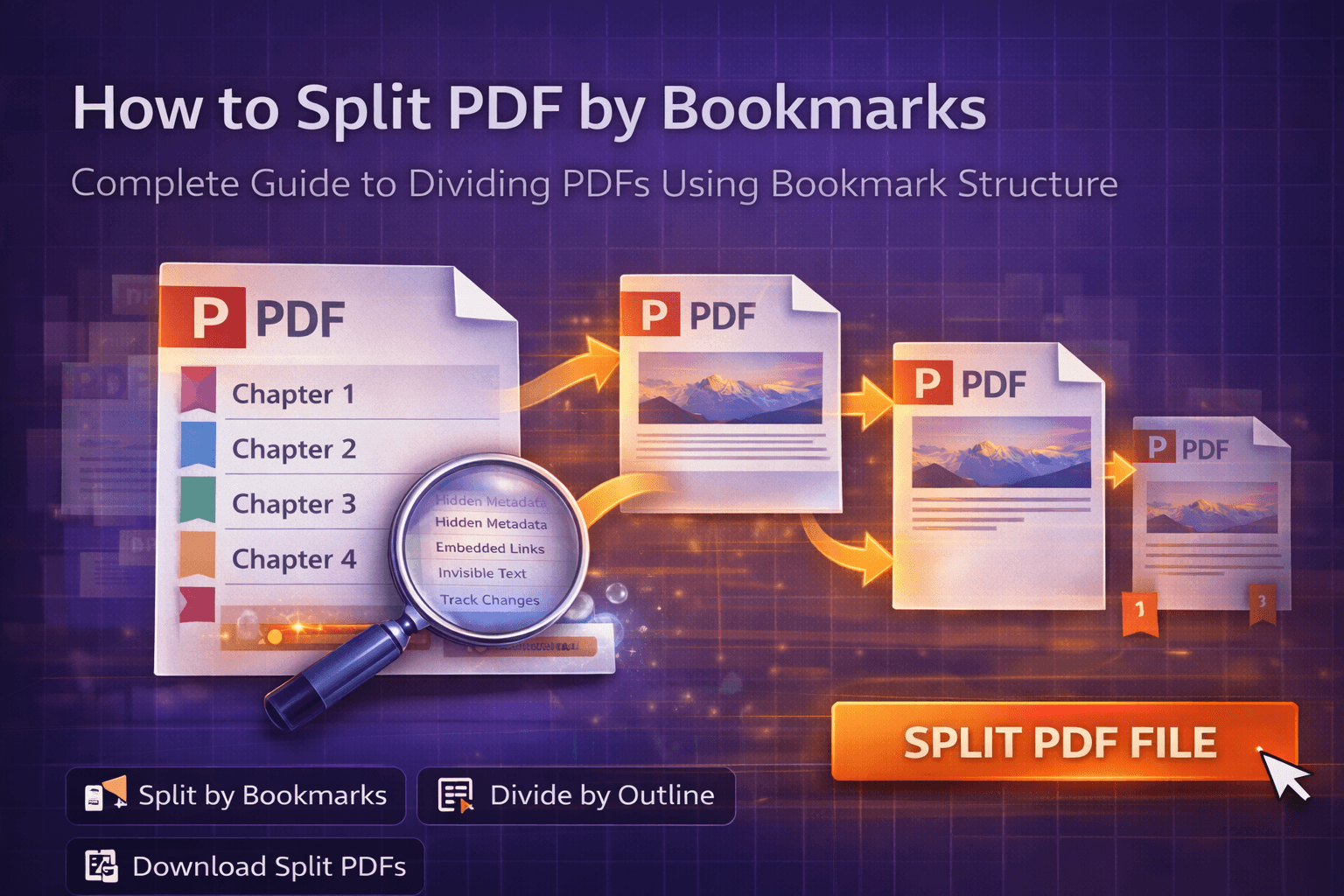
You've got a 300-page technical manual, a comprehensive research report, or a multi-chapter e-book. The document is well-organized with bookmarks—those clickable navigation links in the sidebar that let you jump between sections. But now you need to split it into separate files, one for each chapter or section. Manually selecting page ranges would take forever and be prone to errors. There has to be a better way.
There is. Splitting PDFs by bookmarks is one of those features that feels like magic when you first use it. Instead of painstakingly figuring out which pages belong to which section, you let the PDF's own organizational structure do the work. This guide will walk you through everything you need to know about splitting PDFs by bookmarks—from understanding what bookmarks are to mastering the technique for your specific needs.
The Problem: Why Manual PDF Splitting Is So Frustrating
Let's say you have a 200-page company handbook with 15 distinct sections. Each section covers a different policy area—HR policies, IT guidelines, safety procedures, and so on. Your boss wants you to create separate PDF files for each section so they can be distributed to different departments or uploaded to different parts of the company intranet.
The manual approach goes something like this: Open the PDF, scroll through to find where each section starts and ends, note the page numbers, then use a PDF splitter to extract those specific page ranges. For 15 sections, that's 15 separate operations. Each one requires you to:
- Manually identify section boundaries
- Count pages or scroll through to find exact page numbers
- Enter page ranges into a splitter tool
- Repeat the process for every section
- Double-check that you didn't miss any pages or include wrong ones
This process is not just time-consuming—it's error-prone. You might accidentally include a page from the next section, or miss the last page of a section. If the document gets updated and page numbers shift, you have to start over. And if you're dealing with a document that has dozens of sections, the manual approach becomes completely impractical.
The real kicker? Most PDFs already have this organizational information built right in—it's called bookmarks, or PDF outlines. They're the navigation structure that appears in the sidebar of PDF readers. The problem is that most people don't realize they can use this existing structure to automate the splitting process entirely.
Why This Problem Matters More Than You Think
Splitting PDFs by bookmarks isn't just a convenience feature—it's a productivity game-changer for anyone who regularly works with structured documents. Consider these real-world scenarios where this capability becomes essential:
- Publishers and content creators: Breaking down e-books or digital magazines into individual chapters for distribution or sale
- Corporate training departments: Splitting comprehensive training manuals into module-specific documents for different courses
- Legal professionals: Dividing large case files or legal compendiums into individual case documents or topic-specific files
- Academic researchers: Separating multi-chapter research papers or thesis documents into individual chapter files for review or submission
- Technical writers: Breaking down software documentation into feature-specific guides or API reference sections
- HR departments: Splitting employee handbooks into policy-specific documents for different departments or roles
- Consultants and agencies: Dividing comprehensive proposals or reports into section-specific deliverables for clients
- Educational institutions: Separating course materials or curriculum guides into individual unit documents
The time savings are substantial. What might take an hour of manual work can be completed in under a minute with bookmark-based splitting. But beyond time, there are other critical benefits:
- Accuracy: No risk of missing pages or including wrong sections—the bookmark structure defines the boundaries
- Consistency: Every split follows the same organizational logic as the original document
- Scalability: Works just as efficiently for 5 sections as it does for 50
- Maintainability: If the source document is updated, you can re-split it using the same bookmark structure
- Professional results: Each split file maintains the document's structure and formatting
The challenge is that many people either don't know this feature exists, or they assume it requires expensive software or technical expertise. The reality is that modern online tools make splitting PDFs by bookmarks as simple as uploading a file and clicking a button.
The Solution: Understanding PDF Bookmarks and How They Enable Smart Splitting
Before we dive into how to split PDFs by bookmarks, let's understand what bookmarks actually are and why they're so powerful for document organization.
PDF bookmarks—also called PDF outlines or the document's table of contents—are navigational elements embedded in PDF files. When you open a PDF in a reader like Adobe Acrobat or your browser's PDF viewer, you'll often see a sidebar panel (usually on the left) that shows a clickable outline of the document's structure. Click on a bookmark, and you jump directly to that section.
These bookmarks aren't just visual navigation aids—they contain actual structural information about the document:
- Section titles: The text labels that appear in the bookmark panel
- Page references: Exact page numbers where each section begins
- Hierarchical structure: Parent-child relationships showing main sections and subsections
- Navigation targets: Specific locations within pages (not just page numbers)
When you split a PDF by bookmarks, the tool uses this embedded structural information to automatically determine where to divide the document. Instead of you manually specifying "pages 1-25 go to file 1, pages 26-48 go to file 2," the tool reads the bookmarks and says "this bookmark starts at page 1, the next one starts at page 26, so the first section is pages 1-25."
This is where bookmark levels become important. Most structured PDFs have a hierarchical bookmark structure:
- Level 1 bookmarks: Top-level sections (e.g., "Chapter 1", "Chapter 2", "Introduction")
- Level 2 bookmarks: Subsections within level 1 (e.g., "Chapter 1" might have "Section 1.1", "Section 1.2")
- Level 3+ bookmarks: Further nested subsections
When splitting, you choose which level to split at. Split at level 1, and you get one file per main chapter. Split at level 2, and you get one file per subsection. This flexibility lets you control the granularity of your splits based on your specific needs.
Modern online PDF splitting tools leverage this bookmark structure to provide a one-click solution. Our split by bookmarks tool automatically detects bookmarks in your PDF, shows you the available levels, and lets you split the document with a single click. No manual page counting, no guesswork, no errors.
Step-by-Step Guide: How to Split PDF by Bookmarks Using Our Tool
Ready to split your PDF using bookmarks? Follow these steps to divide your document automatically based on its bookmark structure. The entire process takes less than a minute for most documents.
Step 1: Verify Your PDF Has Bookmarks
Before you start, make sure your PDF actually contains bookmarks. You can check this by opening the PDF in any PDF reader and looking for the bookmarks panel (usually a sidebar on the left). If you see a clickable outline or table of contents, your PDF has bookmarks.
What if your PDF doesn't have bookmarks? You have a few options:
- Add bookmarks using a PDF editing tool before splitting
- Use alternative splitting methods like splitting by page ranges or file size
- Use our PDF editing tool to add bookmarks to your document first
Most professionally created PDFs—especially those exported from Word, InDesign, or other document creation software—already include bookmarks. Scanned PDFs or simple image-based PDFs typically don't have bookmarks unless they've been processed with OCR and structure recognition.
Step 2: Access the Split by Bookmarks Tool
Navigate to our split by bookmarks page. You'll see a clean, intuitive interface designed specifically for bookmark-based splitting. No account creation or login required—you can start immediately.
The interface is optimized for this specific use case, so you won't be overwhelmed with options you don't need. Everything is focused on making bookmark-based splitting as straightforward as possible.
Step 3: Upload Your PDF File
Click the upload area or drag and drop your PDF file directly onto the page. The tool will immediately begin analyzing your PDF to detect bookmarks. This analysis happens entirely in your browser—your file never leaves your device.
The tool supports:
- Drag and drop functionality for quick file upload
- Files up to 25 MB (for optimal performance)
- Any PDF file with bookmark structure
- Password-protected PDFs (you'll need to unlock them first using our PDF editing tool)
After upload, the tool automatically scans your PDF for bookmarks. If bookmarks are found, you'll see information about the bookmark structure. If no bookmarks are detected, you'll get a clear message explaining that bookmarks are required for this splitting method.
Step 4: Review the Bookmark Structure
Once your PDF is uploaded and analyzed, the tool displays information about the bookmark structure:
- Available bookmark levels: Shows which levels exist in your PDF (e.g., "Levels 1, 2, 3")
- Bookmark count: How many bookmarks exist at each level
- Preview of bookmarks: A list showing the bookmark titles and their hierarchy
This preview helps you understand the document's structure and make an informed decision about which level to split at. For example:
- If you see "Level 1: 5 bookmarks" and "Level 2: 25 bookmarks", splitting at level 1 will create 5 files (one per main section), while level 2 will create 25 files (one per subsection)
- If your document has a flat structure with only level 1 bookmarks, you'll only see level 1 as an option
Take a moment to review this information. Understanding your document's structure ensures you choose the right splitting level for your needs.
Step 5: Select the Bookmark Level
Choose which bookmark level you want to split at. This is the key decision that determines how many files you'll get and how they'll be organized:
- Level 1 (top-level): Creates one file per main section or chapter. Best for dividing large documents into major parts.
- Level 2 (subsections): Creates one file per subsection. Best when you need more granular splits within chapters.
- Level 3+ (nested subsections): Creates files for even more specific sections. Use when you need very detailed separation.
Pro tip: Start with level 1 to see how the splits look. You can always re-split at a different level if you need more or fewer files. The tool shows you how many files will be created before you split, so you can adjust if needed.
The tool typically defaults to level 1, which works well for most use cases. If your document has a complex nested structure, you might want to experiment with different levels to find the one that best matches your needs.
Step 6: Review the Split Preview
Before splitting, the tool shows you a preview of what will be created:
- Number of files that will be created
- File names (typically based on bookmark titles)
- Approximate page ranges for each file
This preview lets you verify that the split will work as expected. Check that:
- The number of files matches your expectations
- File names are meaningful and will help you identify each section
- The page ranges look reasonable (no suspiciously small or large sections)
If something doesn't look right, you can adjust the bookmark level or cancel and check your PDF's bookmark structure in a PDF reader first.
Step 7: Click Split and Wait for Processing
Once you're satisfied with the preview, click the "Split by Bookmarks" or "Split PDF" button. The tool will:
- Read the bookmark structure from your PDF
- Determine page ranges for each bookmark section
- Extract pages for each section
- Create separate PDF files for each bookmark
- Generate all split files
Processing time depends on:
- Total page count of your PDF
- Number of bookmarks (more bookmarks = more files to create)
- File size and complexity
- Your device's processing power
For typical documents (100-200 pages, 5-10 bookmarks), processing usually takes just a few seconds. Larger documents with many bookmarks might take 30-60 seconds. You'll see a progress indicator during processing, so you know the tool is working.
Step 8: Download Your Split PDFs
When processing completes, your split PDFs are ready. Each file is named based on the bookmark title, making it easy to identify which section each file contains. You can:
- Download individual files one by one
- Download all files as a ZIP archive (most convenient when you have many files)
- Preview each file before downloading to verify the content
Important: Since processing happens entirely in your browser, your files never leave your device. Once you close the browser tab, all temporary data is cleared. Make sure to download your split PDFs before closing the page.
That's it! You've successfully split your PDF by bookmarks. The entire process—from upload to download—typically takes less than two minutes, even for complex documents with many sections.
Benefits of Splitting PDFs by Bookmarks
Why choose bookmark-based splitting over other methods? Here are the key advantages that make this approach superior for structured documents:
1. Automatic and Accurate
The biggest advantage is automation. You don't need to manually identify section boundaries or count pages. The bookmark structure already contains this information, so the tool can split accurately without any guesswork. This eliminates human error—no accidentally including pages from the wrong section or missing the last page of a chapter.
2. Respects Document Structure
When you split by bookmarks, you're using the document's own organizational logic. The person who created the PDF already decided how to structure it—bookmarks reflect those decisions. By splitting at bookmark boundaries, you maintain the intended document organization rather than imposing an arbitrary page-based division.
3. Scalable to Any Number of Sections
Whether your document has 3 sections or 300, bookmark-based splitting handles it with the same ease. There's no difference in effort between splitting a 5-chapter book and a 50-section manual. This scalability makes it perfect for large, complex documents that would be impractical to split manually.
4. Meaningful File Names
When splitting by bookmarks, the resulting files are typically named after the bookmark titles. Instead of generic names like "split_001.pdf" and "split_002.pdf", you get descriptive names like "Chapter_1_Introduction.pdf" and "Chapter_2_Methodology.pdf". This makes it much easier to identify and organize the split files later.
5. Flexible Granularity Control
The ability to choose bookmark levels gives you control over how granular your splits are. Need broad divisions? Split at level 1. Need detailed separation? Split at level 2 or 3. This flexibility lets you adapt the splitting to your specific workflow needs without having to manually adjust page ranges.
6. Fast and Efficient
What might take an hour of manual work can be completed in under a minute with bookmark-based splitting. The tool processes everything automatically, so you can split complex documents in the time it takes to make a cup of coffee. This time savings becomes even more valuable when you need to split documents regularly.
7. Maintains Document Quality
Splitting by bookmarks preserves the original document's formatting, images, and structure. Each split file maintains the same quality as the original pages, with no degradation or compression artifacts. This is especially important for professional documents where quality matters.
8. Reusable Process
If the source document gets updated (new version with same bookmark structure), you can re-split it using the same bookmark level. The process is consistent and repeatable, making it ideal for documents that are regularly updated and need to be re-split.
Comparison: Splitting by Bookmarks vs. Other Methods
How does bookmark-based splitting compare to other PDF splitting methods? Let's break down the differences:
Splitting by Bookmarks vs. Splitting by Page Ranges
Splitting by Page Ranges:
- ✅ Works with any PDF, even without bookmarks
- ✅ Gives you precise control over exact page numbers
- ✅ Good for simple, uniform splits (every 10 pages, etc.)
- ❌ Requires manual page counting and range specification
- ❌ Time-consuming for many sections
- ❌ Error-prone (easy to miscount or include wrong pages)
- ❌ Doesn't respect document structure
- ❌ Generic file names
Splitting by Bookmarks:
- ✅ Automatic—no manual page counting
- ✅ Respects document's organizational structure
- ✅ Fast even for many sections
- ✅ Meaningful, descriptive file names
- ✅ Eliminates human error
- ✅ Scalable to any number of sections
- ❌ Requires PDF to have bookmarks
- ❌ Less control over exact page boundaries
Verdict: For structured documents with bookmarks, bookmark-based splitting is clearly superior. Use page ranges when you need precise control or when your PDF doesn't have bookmarks. Many tools, including ours, offer both methods so you can choose based on your document and needs.
Splitting by Bookmarks vs. Splitting by File Size
Splitting by File Size:
- ✅ Ensures each file is under a specific size limit
- ✅ Good for email size restrictions
- ✅ Works with any PDF
- ❌ Splits at arbitrary page boundaries (may break sections)
- ❌ Doesn't respect document structure
- ❌ Can split in the middle of a section
- ❌ Generic file names
Splitting by Bookmarks:
- ✅ Respects document structure (never splits mid-section)
- ✅ Meaningful file names
- ✅ Each file is a complete, logical section
- ❌ File sizes may vary significantly
- ❌ Some files might exceed size limits
- ❌ Requires bookmarks
Verdict: These methods serve different purposes. Use size-based splitting when you need to meet specific file size requirements. Use bookmark-based splitting when you need to preserve document structure and create logically complete sections. For documents with both needs, you might split by bookmarks first, then use our PDF compression tool on individual files if needed.
Splitting by Bookmarks vs. Manual Extraction
Some people still try to split PDFs manually using methods like:
- Printing specific pages to a new PDF (slow, quality loss, time-consuming)
- Taking screenshots of pages (terrible quality, not searchable, loses formatting)
- Copy-pasting content to Word then exporting (loses formatting, time-consuming)
- Using freeware with ads and potential security risks
Verdict: Bookmark-based splitting is faster, produces better quality results, preserves formatting and searchability, and is more reliable than any manual method. There's no reason to use workarounds when proper tools are available for free.
Frequently Asked Questions About Splitting PDFs by Bookmarks
How do I split a PDF by bookmarks?
You can split a PDF by bookmarks using our free online tool. Upload your PDF file that contains bookmarks, select the bookmark level you want to split at (level 1 for main sections, level 2 for subsections, etc.), and click split. The tool automatically creates separate PDF files for each bookmark section. No account creation or software installation required.
What are PDF bookmarks?
PDF bookmarks, also known as PDF outlines or table of contents, are navigational elements embedded in PDF files. They appear in the bookmarks panel of PDF readers (usually a sidebar) and allow users to jump to specific sections. Bookmarks contain structural information including section titles, page references, and hierarchical relationships. When splitting by bookmarks, each bookmark section becomes a separate PDF file.
Can I split a PDF by bookmarks if it doesn't have bookmarks?
No, you need a PDF with bookmarks to use the split by bookmarks feature. If your PDF doesn't have bookmarks, you have a few options: add bookmarks first using a PDF editing tool like our PDF editing tool, use alternative splitting methods like splitting by page ranges or file size, or use OCR software to add structure to scanned PDFs.
Is it safe to split PDFs by bookmarks online?
Yes, when using a privacy-first PDF splitter that processes files locally in your browser, your documents never leave your device. All splitting happens client-side using JavaScript, ensuring your sensitive documents remain secure and private throughout the process. Unlike cloud-based tools that upload files to servers, client-side processing means your PDFs are processed entirely on your computer. Always look for tools that explicitly state they process files locally rather than uploading them.
What is a bookmark level in PDF splitting?
Bookmark levels refer to the hierarchical structure of bookmarks in a PDF. Level 1 bookmarks are top-level sections (like main chapters), level 2 bookmarks are subsections within level 1 (like sections within chapters), and so on. When splitting by bookmarks, you choose which level to split at. For example, splitting at level 1 creates one file per main chapter, while splitting at level 2 creates files for each subsection. This gives you control over the granularity of your splits.
Can I split a PDF by bookmarks for free?
Yes, our PDF split by bookmarks tool is completely free to use. No account creation, payment, or software installation required. Simply upload your PDF, select your bookmark level, and download the split files. All processing happens in your browser, so there are no subscription fees or usage limits.
How many files will I get when splitting by bookmarks?
The number of files depends on how many bookmarks exist at the level you choose to split at. If you split at level 1 and your PDF has 10 level 1 bookmarks, you'll get 10 files. If you split at level 2 and there are 25 level 2 bookmarks, you'll get 25 files. The tool shows you how many files will be created before you split, so you can adjust the bookmark level if needed.
Will splitting by bookmarks reduce file quality?
No, properly splitting a PDF by bookmarks should not reduce quality. The tool extracts pages at the native PDF level without re-compressing or degrading the content. Each split PDF maintains the same quality as the original pages, preserving images, text, and formatting exactly as they appear in the source document.
Can I split password-protected PDFs by bookmarks?
Most online PDF splitters cannot process password-protected PDFs because they can't access the content without the password. You'll need to remove password protection first using a PDF editing tool or the software that created the protection, then split the unlocked file by bookmarks. Some desktop PDF software can handle password-protected files if you provide the password.
What happens if my PDF has nested bookmarks?
Nested bookmarks (bookmarks with multiple levels) work perfectly with bookmark-based splitting. You simply choose which level to split at. If you have a document with chapters (level 1) containing sections (level 2) containing subsections (level 3), you can split at any of these levels. Splitting at level 1 gives you one file per chapter, level 2 gives you one file per section, and level 3 gives you one file per subsection.
Can I split PDFs by bookmarks on mobile devices?
Yes, many online PDF splitter tools work on mobile browsers, though the experience may vary. Mobile devices have less processing power and memory than desktop computers, so very large PDFs with many bookmarks might be slower or fail. For best results on mobile, stick to smaller files (under 10 MB) and documents with fewer bookmarks (under 20). The interface may also be optimized differently for touch screens.
What if my bookmark titles have special characters?
The tool automatically sanitizes bookmark titles when creating file names, removing or replacing special characters that aren't valid in filenames. This ensures all split files have valid, usable names regardless of what characters appear in the original bookmark titles. You can always rename the files after downloading if needed.
Conclusion: Making PDF Splitting Intelligent and Automatic
Splitting PDFs by bookmarks transforms what used to be a tedious, error-prone manual task into a one-click automated process. Instead of spending hours counting pages and specifying ranges, you let the document's own structure do the work. The result? Faster, more accurate splits that respect the document's intended organization.
The key advantages of bookmark-based splitting—automation, accuracy, scalability, and meaningful file names—make it the ideal solution for anyone working with structured documents. Whether you're a publisher dividing e-books, a corporate trainer splitting manuals, or a researcher organizing papers, this method saves time while producing professional results.
Remember these best practices:
- Verify your PDF has bookmarks before attempting to split by bookmarks
- Review the bookmark structure preview to understand available levels
- Start with level 1 and adjust if you need more granular splits
- Use privacy-first tools that process files locally in your browser
- Download split files as a ZIP archive when creating many files
- Keep backups of original files until you're satisfied with the splits
Ready to split your PDFs by bookmarks? Try our free split by bookmarks tool and experience how simple dividing structured documents can be. And if you need to make edits to your PDFs before or after splitting, check out our PDF editing tool for adding text, images, and annotations. For large files that need size reduction, our PDF compression tool can help reduce file sizes. And if you need to combine PDFs later, our PDF merger tool makes it easy to merge documents back together.
PDF management doesn't have to be a chore. With the right tools and approach, you can handle document splitting quickly and confidently, leaving more time for the work that actually matters. Splitting by bookmarks is just one example of how modern PDF tools can make your workflow more efficient—the key is knowing these features exist and how to use them effectively.
Related Articles
How to Split PDF Files Online
Complete guide to splitting PDF files by pages, size, or bookmarks using free online tools.
How to Merge PDF Files Online
Learn how to combine multiple PDF files into one document using free online tools.
How to Edit a PDF Online
Complete guide to editing PDF files online without installing software.
How to Extract Pages from PDF Online
Learn how to extract specific pages from PDF files using free online tools.