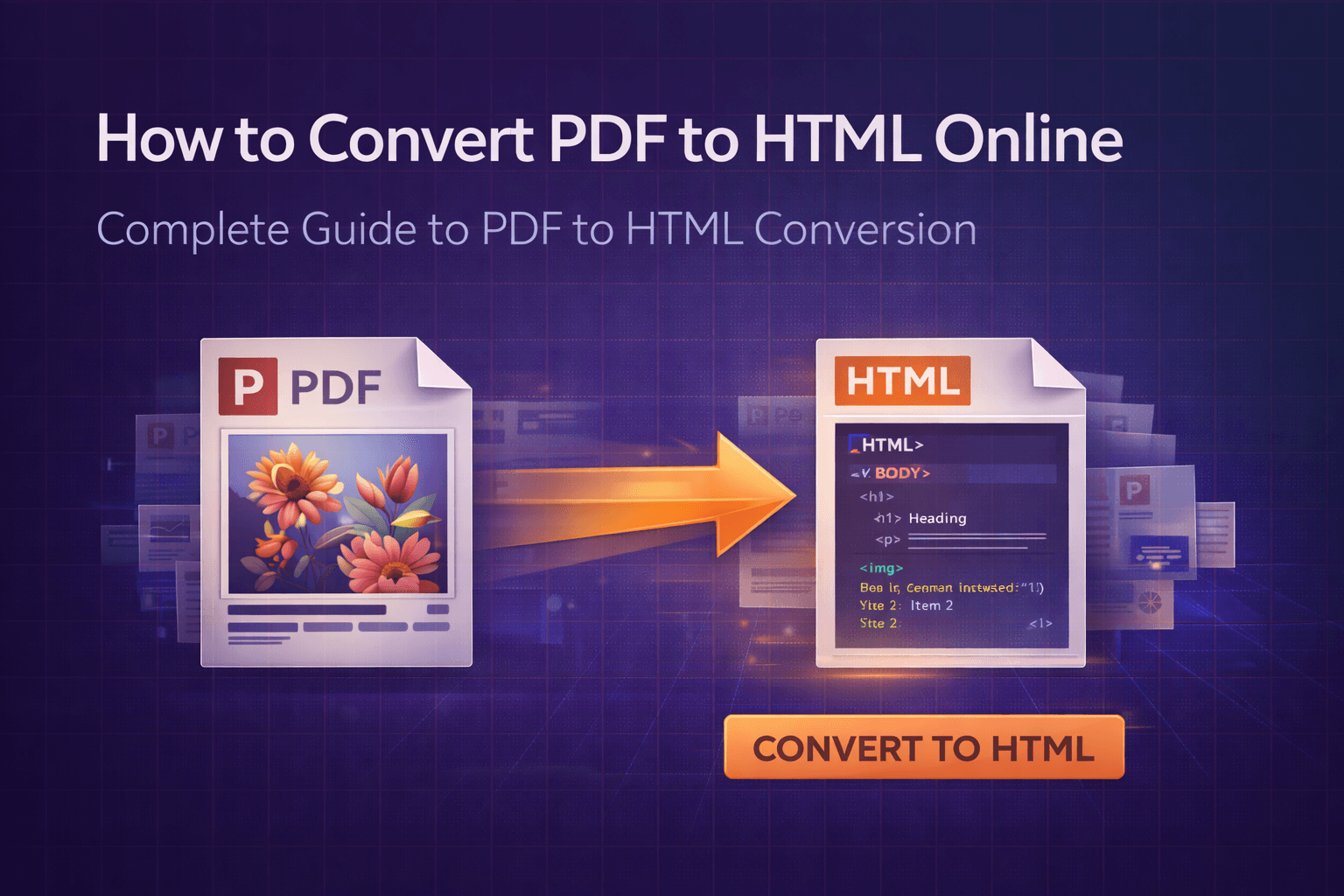
You've got a PDF document that needs to become a web page. Maybe it's a report you want to publish online, a document that needs to be searchable, or content you want to integrate into your website. Whatever the reason, converting PDF to HTML is one of those tasks that seems straightforward but can quickly become complicated if you don't know the right approach.
The good news? You don't need expensive software or coding expertise. Modern online PDF to HTML converter tools make transforming PDF documents into web-ready HTML files as simple as uploading a file and clicking a button. This comprehensive guide will walk you through everything you need to know about PDF to HTML conversion, from understanding why you'd want to do it to handling edge cases and ensuring your converted content looks great on the web.
The Problem: Why Converting PDF to HTML Can Be Challenging
PDFs are fantastic for preserving document formatting and ensuring consistent appearance across devices. But they're not designed for the web. When you need PDF content to be searchable, editable, or integrated into a website, you run into several challenges that make simple conversion difficult.
Here's what makes PDF to HTML conversion tricky:
- Format complexity: PDFs can contain complex layouts, embedded fonts, images, and vector graphics that don't translate directly to HTML
- Layout preservation: Maintaining exact positioning and spacing from PDF to HTML requires sophisticated conversion algorithms
- Text extraction issues: Scanned PDFs or image-based PDFs require OCR (Optical Character Recognition) to extract text, which adds complexity
- File size concerns: Large PDFs can create bloated HTML files that load slowly on websites
- Security and privacy: Uploading sensitive documents to unknown servers raises legitimate privacy concerns
- Software requirements: Desktop conversion tools often require installation, updates, and sometimes payment
- Code quality: Poor converters produce messy HTML with inline styles, nested tables, and non-semantic markup that's hard to maintain
These challenges are exactly why specialized PDF to HTML converter tools have become essential. They handle the technical complexity while giving you clean, usable HTML output that works well on modern websites.
Why This Problem Matters More Than You Think
Converting PDF to HTML might seem like a niche task, but it's actually something countless professionals and businesses need to do regularly. Consider these real-world scenarios:
- Web developers converting client documents into web pages for company websites
- Content creators transforming PDF newsletters or magazines into online articles
- Marketing teams converting PDF brochures and flyers into web content for better SEO and accessibility
- Documentation teams making PDF manuals and guides searchable and accessible online
- Legal professionals converting case documents into web-accessible formats for client portals
- Educational institutions transforming PDF course materials into interactive web pages
- E-commerce businesses converting product catalogs from PDF to HTML for better searchability
- Bloggers and publishers turning PDF articles into web content that search engines can index
The benefits of converting PDF to HTML go beyond just making content web-friendly. HTML versions of PDF documents offer:
- Better search engine optimization (SEO) since search engines can index HTML content more effectively
- Improved accessibility for screen readers and assistive technologies
- Faster loading times compared to embedded PDF viewers
- Mobile-friendly responsive layouts that adapt to different screen sizes
- Easier content editing and updates without needing PDF editing software
- Better user experience with native web navigation and linking
The time and effort saved by using the right PDF to HTML conversion tool can be substantial. What takes hours of manual work or expensive software can be accomplished in minutes with modern online converters. More importantly, the wrong approach can lead to broken layouts, lost formatting, security concerns, and frustrated users.
The Solution: Modern Online PDF to HTML Converters
The solution to PDF to HTML conversion challenges is simpler than you might expect. Modern web-based PDF to HTML converter tools handle all the technical complexity behind the scenes, giving you a clean interface to transform documents in minutes.
What makes these tools effective? They leverage advanced browser-based PDF processing technology that works entirely in your web browser. This means:
- No installation required: Works on any device with a modern browser—Windows, Mac, Linux, or mobile
- Privacy-first processing: Files stay on your device, never uploaded to servers, ensuring your sensitive documents remain secure
- Instant results: Convert PDF to HTML in seconds, not minutes
- Free to use: No subscriptions, hidden fees, or account requirements
- Clean HTML output: Produces semantic, well-structured HTML that's easy to work with
- Formatting preservation: Maintains text styles, fonts, and basic layout from your PDF
- Page selection: Convert entire documents or specific page ranges
- Cross-platform compatibility: Works everywhere, regardless of your operating system
The best part? You don't need to understand how PDF parsing or HTML generation works technically. The tool handles text extraction, formatting conversion, and HTML structure creation automatically. You just need to know how to use the interface—which is exactly what we'll cover next.
Our PDF to HTML converter tool is built with these principles in mind. It's designed to be fast, secure, and straightforward—everything you need without the complexity you don't. Whether you're converting a simple text document or a complex multi-page report, the tool handles the conversion process seamlessly.
Step-by-Step Guide: How to Convert PDF to HTML Using Our Tool
Ready to convert your PDF to HTML? Follow these steps to transform your PDF document into a web-ready HTML file quickly and easily. We'll walk through the entire process from upload to download, including tips for getting the best results.
Step 1: Access the PDF to HTML Converter Tool
Navigate to our PDF to HTML converter page. You'll see a clean, intuitive interface with a file upload area. No account creation, login, or registration required—you can start converting immediately. The interface is designed to be straightforward, so you can focus on your conversion rather than figuring out how the tool works.
Step 2: Upload Your PDF File
Click the upload area or drag and drop your PDF file directly onto the page. The tool supports:
- Drag and drop functionality for quick file upload
- Standard PDF files (.pdf extension)
- Files up to 25 MB (for optimal performance)
- Any PDF file, regardless of page count or complexity
- Text-based PDFs and scanned PDFs (though text-based PDFs produce better results)
Once uploaded, you'll see a preview or confirmation that your file is ready. The tool will analyze your PDF and prepare it for conversion. You might see information about the total page count, which helps you decide if you want to convert the entire document or just specific pages.
Pro tip: If your PDF is password-protected, you'll need to unlock it first using our PDF editing tool before converting to HTML. Most converters can't process password-protected files because they can't access the content without the password.
Step 3: Choose Your Conversion Options
Before converting, you can configure several options to customize your HTML output:
Option A: Select Page Range
You don't always need to convert the entire PDF. Most converters let you specify:
- All pages: Convert the entire document (default option)
- Page range: Convert specific pages, like pages 1-10 or pages 5-15
- Individual pages: Convert only specific pages, like pages 1, 3, 5, 7
- Custom ranges: Combine ranges and individual pages, like "1-5, 10, 15-20"
Best for: When you only need specific sections of a large document, or when you want to convert a document in parts.
Option B: Formatting Preferences
Many converters offer options to control how formatting is preserved:
- Preserve formatting: Maintain fonts, styles, and layout from the original PDF
- Clean HTML: Generate semantic HTML without excessive inline styles
- Include images: Embed images from the PDF into the HTML (as base64 or separate files)
- Text only: Extract just the text content without formatting
Best for: Most use cases benefit from preserving formatting, but text-only extraction is useful when you want to repurpose content in a different design.
Option C: Output Customization
Some advanced converters let you customize the HTML output:
- Add custom CSS styles
- Choose HTML structure (divs, sections, articles)
- Include or exclude metadata
- Set character encoding
Best for: Advanced users who need specific HTML structure for integration into existing websites or content management systems.
Step 4: Review Your Settings
Before converting, take a moment to verify your settings:
- Your PDF file is correct and complete
- Page range is accurate (if you selected specific pages)
- Formatting preferences match your needs
- File size is reasonable (under 25 MB for best performance)
This quick check prevents having to start over if you realize something's wrong after conversion. It's especially important when converting large documents, as re-conversion takes time.
Step 5: Click Convert and Wait for Processing
Once everything looks good, click the "Convert to HTML" or "Convert PDF" button. The tool will:
- Parse your PDF file structure
- Extract text content from the selected pages
- Preserve formatting and styles where possible
- Generate clean, semantic HTML markup
- Create a downloadable HTML file
Processing time depends on several factors:
- Total page count of your PDF
- Number of pages being converted
- File size and complexity
- Your device's processing power
- Whether images are being included
For typical conversions (10-50 pages), this usually takes just a few seconds. Larger conversions (100+ pages) might take 30-60 seconds. Very complex PDFs with lots of graphics might take longer. You'll see a progress indicator during processing, so you know the tool is working.
Step 6: Preview and Download Your HTML File
When processing completes, your HTML file is ready. Many converters offer a preview so you can see how the converted content looks before downloading. You can:
- Preview the HTML in your browser
- Check formatting and layout
- Verify that all content converted correctly
- Download the HTML file to your device
- Copy the HTML code directly if needed
The downloaded file will typically be named something like "converted.html" or based on your original PDF filename. You can rename it to something more descriptive if needed.
Important: Since processing happens in your browser, your files never leave your device. Once you close the browser tab, all temporary data is cleared. Make sure to download your HTML file before closing the page if you need to keep it.
That's it! You've successfully converted your PDF to HTML. The entire process typically takes less than two minutes from start to finish, and you now have a web-ready HTML file that you can use on your website, edit in any HTML editor, or integrate into your web applications.
Benefits of Using Online PDF to HTML Converters
Why choose an online PDF to HTML converter over desktop software or manual conversion methods? Here are the key advantages that make online tools the preferred choice for most users:
1. Zero Installation Required
The biggest advantage is simplicity. You don't need to download, install, or update any software. Just open your browser and start converting. This is especially valuable when you're on a shared computer, work device with restricted permissions, or need to convert PDFs on the go. You can access the tool from any device, anywhere, as long as you have internet access.
2. Privacy and Security
When you use a privacy-first PDF to HTML converter that processes files locally in your browser, your documents never leave your device. This is crucial when working with:
- Confidential business documents
- Personal financial information
- Legal documents and contracts
- Medical records and health information
- Proprietary content and trade secrets
- Any sensitive data that shouldn't be uploaded to external servers
Unlike cloud-based tools that upload your files to servers (where they might be stored, analyzed, or accessed by third parties), client-side processing keeps everything on your machine where you have complete control. This privacy-first approach is essential for businesses and individuals who handle sensitive information.
3. Cost-Effective Solution
Most online PDF to HTML converters are completely free. Even premium desktop PDF software can cost $100-300, and subscription services charge monthly fees. For occasional or regular PDF to HTML conversion, free online tools provide excellent value without any financial commitment. You get professional-quality conversion without the professional price tag.
4. Clean, Semantic HTML Output
Modern online converters produce clean, semantic HTML that's easy to work with. Unlike some desktop tools that generate messy HTML with nested tables and inline styles, good online converters create well-structured markup that follows web standards. This makes it easier to integrate converted content into existing websites, edit in HTML editors, and maintain over time.
5. Cross-Platform Compatibility
Whether you're on Windows, Mac, Linux, iOS, or Android, online PDF to HTML converters work everywhere. Desktop software is often platform-specific, forcing you to buy separate versions or find workarounds. Browser-based tools eliminate this limitation entirely—if you can run a modern web browser, you can convert PDFs to HTML.
6. Always Up-to-Date
Online tools are automatically updated by their developers. You always get the latest features, bug fixes, and improvements without manually downloading updates or worrying about version compatibility. As PDF formats evolve and web standards change, online converters adapt automatically, ensuring you always have access to the best conversion technology.
7. Speed and Efficiency
Modern browser-based PDF processing is surprisingly fast. You can convert PDFs to HTML in seconds, compared to:
- Manual copy-paste methods (which don't preserve formatting and are extremely time-consuming)
- Desktop software that requires launching and navigating complex interfaces
- Cloud-based services that require upload and download time
- Hiring developers to write custom conversion scripts
The streamlined interface of online tools means less time clicking through menus and more time getting work done. For busy professionals, this efficiency gain is significant.
8. Flexible Page Selection
Most online converters let you select specific pages or page ranges to convert, which is incredibly useful when you only need part of a document. This flexibility saves time and reduces file size, making it easier to work with the converted HTML. You can convert a 100-page PDF in sections, or extract just the pages you need without processing the entire document.
9. Better SEO and Web Integration
HTML versions of PDF content are much better for search engine optimization than embedded PDFs. Search engines can index HTML content more effectively, making your content discoverable. HTML also integrates seamlessly into websites, content management systems, and web applications, providing a native web experience that users expect.
Comparison: Online PDF to HTML Converters vs. Other Tools
How do online PDF to HTML converter tools stack up against alternatives? Let's break down the comparison to help you choose the right solution for your needs:
Online PDF to HTML Converters vs. Desktop Software
Desktop Software (Adobe Acrobat, PDF Expert, etc.):
- ✅ More advanced features (editing, form filling, etc.)
- ✅ Works offline after installation
- ✅ Better for very large files (500+ pages)
- ✅ More control over conversion settings
- ❌ Requires installation and updates
- ❌ Often expensive ($100-300+ or subscription fees)
- ❌ Platform-specific (Windows or Mac, rarely both)
- ❌ Takes up disk space
- ❌ Slower to get started (download, install, configure)
Online PDF to HTML Converters:
- ✅ Free to use
- ✅ No installation required
- ✅ Works on any platform
- ✅ Always up-to-date
- ✅ Privacy-first (client-side processing)
- ✅ Faster to get started (just open browser)
- ✅ Clean, semantic HTML output
- ❌ Requires internet connection (for initial page load)
- ❌ May struggle with extremely large files (500+ pages)
- ❌ Fewer advanced features (but sufficient for most conversions)
Verdict: For PDF to HTML conversion specifically, online tools win on convenience, cost, and accessibility. Desktop software is better if you need comprehensive PDF editing capabilities beyond just conversion, or if you regularly work with very large files and need offline access.
Online PDF to HTML Converters vs. Cloud-Based Services
Cloud-Based Services (Google Drive, Dropbox PDF tools, etc.):
- ✅ Integrated with cloud storage
- ✅ Can access files from anywhere
- ✅ Often free with cloud storage accounts
- ✅ Batch processing capabilities
- ❌ Files uploaded to servers (privacy concern)
- ❌ Requires account creation
- ❌ Storage limits apply
- ❌ Files may be retained on servers
- ❌ Slower processing (upload/download time)
- ❌ Limited conversion options
- ❌ Less control over HTML output quality
Client-Side Online Converters:
- ✅ No file uploads (privacy-first)
- ✅ No account required
- ✅ Faster processing (no upload/download)
- ✅ No storage limits
- ✅ Files never leave your device
- ✅ Better HTML output quality
- ✅ More conversion options and customization
- ❌ Can't access files from cloud storage directly
- ❌ Requires files to be on your device
Verdict: For privacy-conscious users and businesses handling sensitive documents, client-side online converters are superior. Cloud services are better if you need to convert files already stored in cloud storage and don't mind the privacy trade-off, or if you need batch processing of many files.
Online PDF to HTML Converters vs. Manual Methods
Some people try to convert PDFs to HTML manually using methods like:
- Copy-pasting text from PDF viewers (loses formatting, doesn't work with scanned PDFs)
- Taking screenshots and converting to HTML (terrible quality, not searchable, time-consuming)
- Using freeware with ads and malware risks
- Writing custom conversion scripts (requires programming knowledge and significant time investment)
- Printing to HTML (limited functionality, poor quality output)
Verdict: Online PDF to HTML converters are faster, produce better quality results, preserve formatting, maintain searchability, and are more reliable than any manual method. There's no reason to use workarounds when proper tools are available for free. The time saved alone makes online converters the obvious choice.
Online PDF to HTML Converters vs. Programming Libraries
Programming Libraries (Python pdf2html, Node.js libraries, etc.):
- ✅ Maximum control and customization
- ✅ Can be integrated into applications
- ✅ Automated batch processing
- ✅ No file size limits (depends on server resources)
- ❌ Requires programming knowledge
- ❌ Time-consuming to set up and maintain
- ❌ Need to handle errors and edge cases
- ❌ Server and infrastructure costs
- ❌ Ongoing maintenance and updates
Online PDF to HTML Converters:
- ✅ No programming required
- ✅ Instant access, no setup
- ✅ User-friendly interface
- ✅ Free to use
- ✅ No maintenance required
- ❌ Less customization than programming solutions
- ❌ Not suitable for automated batch processing
- ❌ Manual operation required
Verdict: For one-off or occasional conversions, online converters are much more practical. Programming libraries are better if you need to integrate PDF to HTML conversion into an application, automate the process, or handle large-scale batch conversions regularly.
Frequently Asked Questions About PDF to HTML Conversion
How do I convert PDF to HTML online for free?
You can convert PDF to HTML online for free by using our PDF to HTML converter tool. Simply upload your PDF file, choose your conversion options (page range, formatting preferences), and click convert. The tool transforms your PDF into an HTML file that you can download and use on any website. No account creation, payment, or software installation required.
Is it safe to convert PDF to HTML online?
Yes, when using a privacy-first PDF to HTML converter that processes files locally in your browser, your documents never leave your device. All conversion happens client-side using JavaScript, ensuring your sensitive documents remain secure and private. Unlike cloud-based tools that upload files to servers, client-side processing means your PDFs are processed entirely on your computer. Always look for tools that explicitly state they process files locally rather than uploading them.
Can I convert specific pages from a PDF to HTML?
Absolutely. Most online PDF to HTML converters allow you to select specific pages or page ranges to convert. You can convert all pages, a specific range like pages 1-10, or individual pages like 1, 3, 5. Some tools even support complex ranges like "1-5, 10, 15-20". This is particularly useful when you only need certain sections of a document, want to reduce file size, or need to convert a large document in parts.
What is the maximum file size for converting PDF to HTML online?
File size limits vary by tool, but most online PDF to HTML converters support files up to 25-50 MB. For best performance, keep files under 25 MB and limit the total number of pages to under 200. Very large files (100+ MB) may cause browser performance issues or timeouts. If you need to convert very large PDFs, consider splitting them first using our PDF splitter tool, or using desktop software designed for heavy-duty processing.
Do I need to create an account to convert PDF to HTML?
No, many free PDF to HTML converter tools work without requiring account creation or registration. You can upload, convert, and download your HTML files immediately without signing up. This makes the process faster and more private. Some tools offer optional accounts for saving conversion history or accessing premium features, but basic PDF to HTML conversion is typically available without any registration.
Will converting PDF to HTML preserve formatting?
Most modern PDF to HTML converters preserve basic formatting like text styles, fonts, headings, and basic layout. However, complex layouts, advanced graphics, precise positioning, and multi-column layouts may not translate perfectly. The quality depends on the PDF structure and the converter tool you use. Text-based PDFs generally convert better than scanned PDFs or image-based PDFs. For best results, use PDFs that were created from text documents rather than scanned images.
Can I convert PDF images to HTML?
Yes, many PDF to HTML converters can include images from your PDF in the HTML output. Images are typically embedded as base64 data (inline in the HTML) or extracted as separate image files. Check your converter's options to enable image inclusion during conversion. Note that including images will increase the HTML file size significantly, so use this option only when necessary. For web use, you might want to extract images separately and reference them in the HTML for better performance.
What can I do with HTML files converted from PDF?
HTML files converted from PDF can be used in many ways: display PDF content on websites, make documents searchable and accessible to search engines, edit content in HTML editors or content management systems, integrate PDF content into web applications, improve SEO by making content indexable, create responsive web pages that work on mobile devices, and share content without requiring PDF viewers. The HTML format is much more flexible than PDF for web use.
Can I convert password-protected PDFs to HTML?
Most online PDF to HTML converters cannot process password-protected PDFs because they can't access the content without the password. You'll need to remove password protection first using our PDF editing tool or the software that created the protection, then convert the unlocked files. Some desktop PDF software can handle password-protected files if you provide the password during conversion.
Will the HTML file be mobile-friendly?
The mobile-friendliness of converted HTML depends on the converter tool and the original PDF structure. Most modern converters produce HTML that works on mobile devices, but it may not be fully responsive. You may need to add CSS media queries or responsive design elements after conversion to ensure optimal mobile experience. For best results, test the converted HTML on mobile devices and adjust the CSS as needed.
Can I edit the HTML after conversion?
Absolutely! One of the main advantages of converting PDF to HTML is that you can edit the HTML file in any text editor, HTML editor, or content management system. You can modify text, change styles, add links, update content, and customize the design. This flexibility is one of the key reasons people convert PDFs to HTML—it makes content editable and maintainable in ways that PDFs are not.
How accurate is the conversion?
Conversion accuracy depends on several factors: the complexity of your PDF, whether it's text-based or scanned, the quality of the original document, and the converter tool you use. Text-based PDFs with simple layouts typically convert with 95%+ accuracy. Scanned PDFs or complex layouts may have lower accuracy. Always review the converted HTML to ensure important content converted correctly, especially for critical documents.
Can I convert PDFs to HTML on mobile devices?
Yes, many online PDF to HTML converter tools work on mobile browsers, though the experience may vary. Mobile devices have less processing power and memory than desktop computers, so very large conversions might be slower or fail. For best results on mobile, stick to smaller files (under 10 MB) and fewer total pages (under 50). The interface may also be optimized differently for touch screens, but core functionality should work.
What's the difference between PDF to HTML and PDF to text conversion?
PDF to HTML conversion preserves formatting, structure, and layout, creating a web-ready HTML file that looks similar to the original PDF. PDF to text conversion extracts only the text content without any formatting, creating a plain text file. Use HTML conversion when you want to display content on a website with formatting preserved. Use text conversion when you only need the raw text content for analysis, processing, or simple display.
Conclusion: Making PDF to HTML Conversion Simple
Converting PDF files to HTML doesn't have to be complicated. With modern online PDF to HTML converter tools, transforming documents into web-ready HTML files is straightforward, fast, and secure. Whether you're a web developer integrating client content, a content creator publishing online, or anyone who needs to make PDF content web-accessible, the right tool makes all the difference.
The key advantages of online PDF to HTML converters—no installation, privacy-first processing, free access, clean HTML output, and cross-platform compatibility—make them the ideal solution for most conversion needs. While desktop software has its place for advanced PDF editing tasks, simple PDF to HTML conversion is perfectly handled by browser-based tools.
Remember these best practices for successful PDF to HTML conversion:
- Use text-based PDFs rather than scanned PDFs for best results
- Keep files under 25 MB for optimal performance
- Use privacy-first tools that process files locally
- Select specific pages when you only need part of a document
- Review the converted HTML to ensure accuracy
- Test the HTML on different devices and browsers
- Consider adding responsive CSS for mobile optimization
- Keep backups of original PDFs until you're satisfied with the conversion
Ready to convert your PDFs to HTML? Try our free PDF to HTML converter tool and experience how simple transforming documents can be. And if you need to make edits to your PDFs before converting, check out our PDF editing tool for adding text, images, and annotations. For large files that need size reduction, our PDF compression tool can help reduce file sizes before conversion. And if you need to combine multiple PDFs before converting, our PDF merger tool makes it easy to merge documents together.
PDF to HTML conversion doesn't have to be a chore. With the right tools and approach, you can transform documents quickly and confidently, making your content web-ready and accessible to a broader audience. The web is built on HTML, and converting your PDFs to HTML opens up endless possibilities for sharing, editing, and integrating your content online.
Related Articles
How to Merge PDF Files Online
Learn how to combine multiple PDF files into one document using free online tools.
How to Split PDF Files Online
Complete guide to dividing large PDF documents into smaller files using free online tools.
How to Edit a PDF Online
Complete guide to editing PDF files online without installing software.
How to Convert PDF to Word Online
Learn how to transform PDF documents into editable Word files using free online tools.