
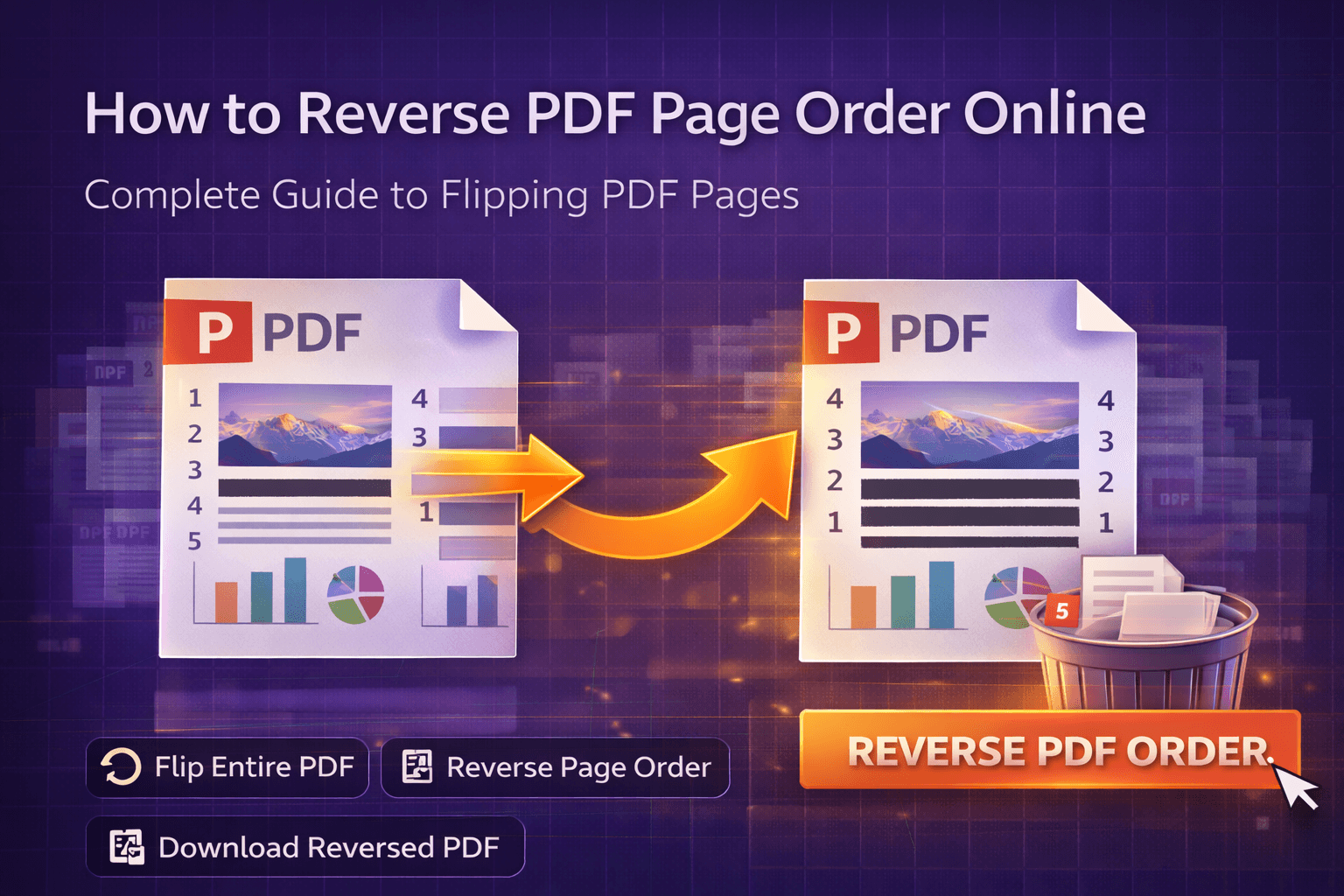
You've just scanned a 30-page document, and when you open the PDF, you realize the pages are completely backwards. Page 30 is first, page 1 is last. Or maybe you're working with a presentation that exported in reverse order, or a report where the pages got flipped during creation. Whatever the situation, having pages in reverse order is frustrating—especially when you need the document ready in minutes, not hours.
The good news? Reversing PDF page order is now one of the simplest PDF tasks you can do. Modern online PDF page reverser tools let you flip all pages from back to front with a single click, all without installing software or compromising your document's security. This comprehensive guide will walk you through everything you need to know about reversing PDF page order online, from understanding when you need this feature to mastering the process in seconds.
The Problem: Why PDF Pages End Up in Reverse Order
PDF pages don't just randomly reverse themselves. There are several common scenarios where pages end up backwards, and understanding these helps you prevent future issues while fixing current ones quickly.
Here's what typically causes reverse page order problems:
- Scanning errors: Multi-page scanners, especially automatic document feeders (ADF), sometimes scan pages in reverse order. This happens when pages are fed face-down instead of face-up, or when the scanner's default settings are configured incorrectly
- Double-sided scanning: When scanning double-sided documents, the second side often gets scanned in reverse sequence, causing the entire document to appear backwards
- Export mistakes: Converting documents from Word, PowerPoint, or other formats to PDF can sometimes reverse page order, especially with complex documents or when using certain export settings
- Print-to-PDF issues: Printing multiple documents to PDF can result in pages appearing in reverse sequence, particularly when printing from applications that handle page order differently
- Software bugs: Some PDF creation tools have bugs that reverse pages during processing, especially when handling large documents or specific file formats
- Manual assembly errors: When manually combining PDFs, it's easy to accidentally add pages in reverse order, especially when working with multiple source files
- International document standards: Some document formats and printing standards use reverse page order by default, which can cause confusion when converting to PDF
The challenge isn't just identifying the problem—it's fixing it efficiently. Traditional solutions often involve:
- Manually reordering pages one by one (extremely time-consuming for long documents)
- Re-scanning the entire document (wasteful and time-consuming)
- Using expensive desktop software like Adobe Acrobat (costly and requires installation)
- Printing and re-scanning (quality loss and time waste)
- Uploading to cloud services (privacy concerns with sensitive documents)
These pain points are exactly why online PDF page reverser tools have become so popular. They solve the complexity problem while keeping things simple, accessible, and secure—all with a single click. No technical knowledge required, no complicated workflows, just upload, reverse, download.
Why This Problem Matters More Than You Think
You might think reverse page order is a minor inconvenience, but it's actually a critical issue that affects readability, professionalism, and document usability. Consider these real-world scenarios where page order matters:
- Business professionals submitting reports, proposals, or contracts where reverse order makes documents confusing and unprofessional
- Students organizing research papers, thesis documents, or assignment submissions where logical flow is essential for grading
- Legal teams preparing case files, evidence documents, or briefs where page sequence affects argument structure and readability
- Real estate agents compiling property documents, inspection reports, and contracts in proper order for clients
- Healthcare workers organizing patient records, test results, and medical histories chronologically for proper care
- Accountants arranging financial statements, invoices, and receipts in logical sequences for audits and reviews
- Content creators organizing portfolios, presentations, or design documents where visual flow and narrative structure matter
- Architects and engineers arranging technical drawings, specifications, and plans in construction order for project execution
- Publishers and authors preparing manuscripts, books, or publications where page order directly impacts reader experience
The consequences of reverse page order extend beyond simple inconvenience:
- Professional credibility: Documents with pages in reverse order look unprofessional and can damage your reputation, especially in client-facing situations
- Time waste: Recipients spend extra time trying to understand backwards documents, leading to frustration and potential misunderstandings
- Miscommunication: Important information gets missed when pages are in reverse sequence, potentially leading to errors or missed deadlines
- Compliance issues: Legal and regulatory documents often require specific page ordering, and reverse order can cause compliance problems
- Workflow disruption: Team members waste time reorganizing documents that should have been correct from the start
- Client frustration: Clients receiving backwards documents may question your attention to detail and professionalism
- Printing problems: Reverse page order causes issues when printing documents, especially for double-sided printing or binding
That's why understanding how to reverse PDF page order properly isn't just about fixing mistakes—it's about maintaining professional standards, ensuring document usability, and saving time for everyone who interacts with your PDFs. The right tool and approach can turn a frustrating problem into a quick, simple task that takes seconds instead of hours.
The Solution: Modern Online PDF Page Reverser Tools
The solution to reverse page order headaches is simpler than you might expect. Modern web-based PDF reverser tools handle all the technical complexity behind the scenes, giving you a clean interface to flip pages in seconds—literally one click and you're done.
What makes these tools effective? They leverage browser-based PDF processing technology that works entirely in your web browser. This means:
- No installation required: Works on any device with a modern browser—Windows, Mac, Linux, or mobile
- Privacy-first processing: Files stay on your device, never uploaded to servers, keeping sensitive documents secure
- One-click operation: Simply upload and click reverse—no complex settings or configurations needed
- Instant results: Reverse pages in seconds, not minutes, regardless of document length
- Free to use: No subscriptions, hidden fees, or account requirements
- Cross-platform compatibility: Works consistently across all operating systems and devices
- Quality preservation: Pages maintain original quality, formatting, and metadata—just in reverse order
The best part? You don't need to understand how PDF page reversal works technically. The tool handles page extraction, reversal, and file reconstruction automatically. You just need to know how to use the interface—which is exactly what we'll cover next.
Our PDF page reverser tool is built with these principles in mind. It's designed to be fast, secure, and straightforward—everything you need without the complexity you don't. Whether you're fixing a simple 10-page document or reversing a 200-page report, the process remains the same: upload, reverse, download. That's it.
Step-by-Step Guide: How to Reverse PDF Page Order Using Our Tool
Ready to reverse your PDF pages? Follow these simple steps to flip pages from back to front quickly and easily. The entire process takes less than a minute for most documents.
Step 1: Access the PDF Page Reverser Tool
Navigate to our PDF page reverser page. You'll see a clean interface with a file upload area. No account creation or login required—you can start reversing immediately. The interface is designed to be intuitive, so even first-time users can figure it out instantly.
The tool is optimized for speed and simplicity. There are no complicated menus, no confusing options—just a straightforward file upload area and a reverse button.
Step 2: Upload Your PDF File
Click the upload area or drag and drop your PDF file directly onto the page. The tool supports:
- Drag and drop functionality for quick file upload
- Files up to 25-50 MB (for optimal performance)
- Any PDF file, regardless of page count
- Password-protected PDFs (you'll need to unlock them first using our PDF editing tool)
- PDFs with different page sizes mixed together
- Scanned PDFs and text-based PDFs
Once uploaded, the tool will quickly process your PDF and show you a preview or confirmation. Some tools display the total page count, which helps you verify you've uploaded the correct file.
Pro tip: If you have a very large PDF (100+ pages), the upload might take a few seconds. Be patient—the tool is loading all pages into memory to prepare for reversal. For best results, keep files under 25 MB when possible.
Step 3: Review Your PDF (Optional)
Before reversing, you might want to quickly verify:
- You've uploaded the correct file
- The page count matches what you expect
- You actually need to reverse the order (sometimes pages look backwards but are actually correct)
Most tools show you the total page count after upload. If your document has 50 pages and you see "50 pages" displayed, you know the upload was successful. Some tools also show a preview of the first and last pages, which can help you confirm the current order.
Step 4: Click Reverse Order
This is where the magic happens. Once your PDF is uploaded, simply click the "Reverse Order," "Flip Pages," or "Reverse Page Order" button. The tool will:
- Process your PDF file
- Extract all pages in their current order
- Reverse the sequence (last page becomes first, first becomes last)
- Reconstruct the PDF with pages in reversed order
- Preserve all formatting, images, and metadata
- Generate your reversed PDF file
Processing time depends on:
- Total page count of your PDF
- File size
- Complexity of page content (images, fonts, etc.)
- Your device's processing power
For typical reversals (20-50 pages), this usually takes just a few seconds. Larger documents (100+ pages) might take 30-60 seconds. You'll see a progress indicator during processing, so you know the tool is working. The beauty of this process is that it's completely automatic—you don't need to specify which pages to reverse or configure any settings.
Step 5: Wait for Processing
While the tool processes your PDF, you'll typically see:
- A progress indicator or loading animation
- Status messages like "Processing..." or "Reversing pages..."
- Sometimes a percentage complete indicator
What's happening behind the scenes: The tool is using PDF manipulation libraries to extract each page, reverse their order in memory, and reconstruct the PDF file. All of this happens in your browser, so your file never leaves your device. This is why privacy-first tools are so valuable—your sensitive documents stay secure.
Don't close the browser tab during processing. If you do, you'll need to start over. Most reversals complete in under a minute, so it's worth waiting.
Step 6: Download Your Reversed PDF
When processing completes, your reversed PDF is ready. Click the download button to save it to your device. The file will typically have a name like "reversed.pdf" or maintain your original filename with a suffix like "_reversed.pdf".
Important: Since processing happens in your browser, your files never leave your device. Once you close the browser tab, all temporary data is cleared. Make sure to download your reversed PDF before closing the page.
Quality check: After downloading, open your reversed PDF and quickly verify:
- All pages are present (check the page count)
- Pages are in reverse order (the last page should now be first)
- Content quality is preserved (no degradation)
- Formatting looks correct
- Images and graphics display properly
That's it! You've successfully reversed your PDF page order. The entire process typically takes less than a minute from start to finish, even for longer documents. If you need to reverse it back to the original order, simply upload the reversed PDF and reverse it again—reversing twice returns pages to their original sequence.
Benefits of Using Online PDF Page Reverser Tools
Why choose an online PDF page reverser over desktop software or manual methods? Here are the key advantages that make these tools the preferred choice for most users:
1. Zero Installation Required
The biggest advantage is simplicity. You don't need to download, install, or update any software. Just open your browser and start reversing. This is especially valuable when you're on a shared computer, work device with restricted permissions, or need to reverse PDFs on the go. No IT department approval needed, no software conflicts, no version compatibility issues.
2. One-Click Operation
Unlike manual reordering where you need to move pages one by one, reversing page order is a single operation. The tool handles everything automatically:
- No need to select individual pages
- No need to specify page ranges
- No need to configure complex settings
- Just upload and click reverse
This simplicity makes reversing page order one of the fastest PDF operations you can perform. What used to take 15-30 minutes of manual work now takes seconds.
3. Privacy and Security
When you use a privacy-first PDF reverser tool that processes files locally in your browser, your documents never leave your device. This is crucial when working with:
- Confidential business documents
- Personal financial information
- Legal documents
- Medical records
- Proprietary research or data
- Any sensitive information
Unlike cloud-based tools that upload your files to servers, client-side processing keeps everything on your machine where you control it. Your documents are processed in your browser's memory and never transmitted over the internet.
4. Cost-Effective Solution
Most online PDF reverser tools are completely free. Even premium desktop PDF software can cost $100-300, and subscription services charge monthly fees. For occasional or regular PDF page reversal, free online tools provide excellent value without any financial commitment. No trials, no credit cards, no hidden costs.
5. Cross-Platform Compatibility
Whether you're on Windows, Mac, Linux, iOS, or Android, online PDF reverser tools work everywhere. Desktop software is often platform-specific, forcing you to buy separate versions or find workarounds. Browser-based tools eliminate this limitation entirely. The same tool works identically on your work computer, home laptop, tablet, or phone.
6. Always Up-to-Date
Online tools are automatically updated by their developers. You always get the latest features, bug fixes, and security improvements without manually downloading updates or worrying about version compatibility. The tool you use today is the best version available, and tomorrow's improvements are automatically included.
7. Speed and Efficiency
Modern browser-based PDF processing is surprisingly fast. You can reverse pages in seconds, compared to:
- Manual page-by-page reordering (extremely time-consuming)
- Re-scanning documents (wasteful and time-consuming)
- Desktop software that requires launching and navigating complex interfaces
- Cloud services that require upload and download time
The streamlined interface of online tools means less time clicking through menus and more time getting work done. What used to take 15-30 minutes can now be done in under a minute.
8. Quality Preservation
Quality online PDF reverser tools preserve all aspects of your original document: image quality, text formatting, fonts, colors, metadata, and more. Unlike methods that involve printing or converting to images, proper PDF reversal maintains the native PDF structure, ensuring your reversed document looks identical to the original—just with pages in reverse order.
9. No Account Required
Most online PDF reverser tools work without requiring account creation or registration. You can upload, reverse, and download your flipped PDF files immediately without signing up. This makes the process faster, more private, and eliminates the risk of your email being added to marketing lists.
10. Reversible Operation
One of the best features of page reversal is that it's completely reversible. If you reverse a PDF and realize you made a mistake, or if you need the original order back, simply reverse it again. Reversing twice returns pages to their original sequence. This gives you confidence to experiment without fear of losing your original document.
Comparison: Online PDF Reversers vs. Other Tools
How do online PDF page reverser tools stack up against alternatives? Let's break down the comparison to help you understand when each method makes sense:
Online PDF Reversers vs. Desktop Software
Desktop Software (Adobe Acrobat, PDF Expert, etc.):
- ✅ More advanced features (editing, form filling, etc.)
- ✅ Works offline after installation
- ✅ Better for very large files (500+ pages)
- ✅ Can handle complex PDF structures
- ❌ Requires installation and updates
- ❌ Often expensive ($100-300+ or subscription fees)
- ❌ Platform-specific (Windows or Mac, rarely both)
- ❌ Takes up disk space
- ❌ Steeper learning curve
- ❌ More complex interface for simple tasks
Online PDF Reversers:
- ✅ Free to use
- ✅ No installation required
- ✅ Works on any platform
- ✅ Always up-to-date
- ✅ Privacy-first (client-side processing)
- ✅ One-click operation
- ✅ No account required
- ❌ Requires internet connection (for initial page load)
- ❌ May struggle with extremely large files (500+ pages)
- ❌ Fewer advanced features (but sufficient for reversing)
Verdict: For PDF page reversal specifically, online tools win on convenience, cost, and accessibility. Desktop software is better if you need comprehensive PDF editing capabilities beyond just reversing, or if you regularly work with very large files and need offline access.
Online PDF Reversers vs. Manual Reordering
Some people try to reverse PDF pages manually using methods like:
- Using a PDF reorder tool to manually drag each page to its new position (extremely time-consuming for long documents)
- Re-scanning the document in the correct order (wasteful, time-consuming, and quality-degrading)
- Printing and re-scanning (quality loss, time-consuming)
- Manually extracting and recombining pages (tedious and error-prone)
Online PDF Reversers:
- ✅ One-click operation
- ✅ Fast processing (seconds instead of minutes or hours)
- ✅ No quality loss
- ✅ No manual work required
- ✅ Preserves all formatting and metadata
- ✅ Works for documents of any length
Verdict: Online PDF reversers are dramatically faster, produce better quality results, and are more reliable than any manual method. There's no reason to use workarounds when proper tools are available for free. The time saved alone makes online tools the clear winner.
Online PDF Reversers vs. Cloud-Based Services
Cloud-Based Services (Dropbox, Google Drive PDF tools, etc.):
- ✅ Integrated with cloud storage
- ✅ Can access files from anywhere
- ✅ Often free with cloud storage accounts
- ❌ Files uploaded to servers (privacy concern)
- ❌ Requires account creation
- ❌ Storage limits apply
- ❌ Files may be retained on servers
- ❌ Slower processing (upload/download time)
- ❌ Limited reversal options
Client-Side Online Reversers:
- ✅ No file uploads (privacy-first)
- ✅ No account required
- ✅ Faster processing (no upload/download)
- ✅ No storage limits
- ✅ Files never leave your device
- ✅ One-click operation
- ❌ Can't access files from cloud storage directly
Verdict: For privacy-conscious users, client-side online reversers are superior. Cloud services are better if you need to reverse files already stored in cloud storage and don't mind the privacy trade-off, or if you need to access the tool from multiple devices without transferring files.
Frequently Asked Questions About Reversing PDF Page Order
How do I reverse the order of pages in a PDF file online?
You can reverse PDF page order online by using our PDF page reverser tool. Simply upload your PDF file, and the tool will automatically flip all pages from back to front. Click the reverse button to generate your new PDF with pages in reversed order. The last page becomes the first, and the first page becomes the last. No account creation, payment, or software installation required.
Is it safe to reverse PDF page order online?
Yes, when using a privacy-first PDF reverser tool that processes files locally in your browser, your documents never leave your device. All page reversing happens client-side using JavaScript, ensuring your sensitive documents remain secure and private. Unlike cloud-based tools that upload files to servers, client-side processing means your PDFs are processed entirely on your computer. Always look for tools that explicitly state they process files locally rather than uploading them.
Can I reverse only some pages in a PDF?
Most online PDF reverser tools reverse all pages in the document as a single operation. If you need to reverse only specific pages or page ranges, you have a few options: split your PDF first using our PDF splitter tool, reverse the desired section, then merge it back using our PDF merger tool. Alternatively, use a PDF reorder tool to manually rearrange specific pages to their desired positions.
What is the maximum file size for reversing PDF page order online?
File size limits vary by tool, but most online PDF reverser tools support files up to 25-50 MB. For best performance, keep files under 25 MB and limit the total number of pages to under 200. Very large files (100+ MB) may cause browser performance issues or timeouts. If you need to reverse very large PDFs, consider splitting them first using our PDF splitter tool, reversing sections separately, then merging them back together.
Do I need to create an account to reverse PDF page order?
No, many free PDF reverser tools work without requiring account creation or registration. You can upload, reverse, and download your flipped PDF files immediately without signing up. This makes the process faster and more private. Some tools offer optional accounts for saving reversal history or accessing premium features, but basic PDF page reversal is typically available without any registration.
Will reversing PDF page order reduce file quality?
No, properly reversing PDF page order should not reduce quality. When you reverse pages using a quality tool, it rearranges pages without re-compressing or degrading the content. The reversed PDF maintains the same quality as your original document—images stay sharp, text remains crisp, and formatting is preserved. However, if you're using a tool that converts PDFs to images and back, quality loss can occur. Look for tools that reverse PDFs at the native PDF level rather than converting formats.
Can I undo page reversal if I make a mistake?
Since reversing creates a new file, you can't undo in the traditional sense. However, your original PDF file remains unchanged on your device, so you can simply reverse it again to restore the original order. Reversing twice returns pages to their original sequence. It's always a good idea to keep a backup of your original file until you're satisfied with the reversed version.
Why would I need to reverse PDF page order?
Common reasons include fixing documents scanned in reverse order, preparing documents for printing in a specific sequence, organizing presentations that were exported backwards, correcting page order errors from document creation software, fixing double-sided scanning issues, or preparing documents for binding in a particular orientation. It's also useful when working with international document standards that use reverse page order.
Can I reverse password-protected PDFs?
This depends on the tool. Most online PDF reverser tools cannot process password-protected PDFs because they can't access the content without the password. You'll need to remove password protection first using a PDF editing tool or the software that created the protection, then reverse the unlocked files. Some desktop PDF software can handle password-protected files if you provide the password.
What happens if my PDF has different page sizes?
When reversing PDFs with different page sizes (e.g., mixing letter-size and A4 pages), the reversed document will preserve each page's original size. This means your final PDF will contain pages of varying dimensions in reverse order, which is usually fine for most purposes. The reversal operation only changes the sequence of pages, not their individual properties like size, orientation, or content.
Is there a limit to how many pages I can reverse?
There's no hard limit on page count, but practical limits exist based on your device's capabilities. Most online tools handle 100-200 pages comfortably. Very large reversals (500+ pages) may cause browser slowdowns or memory issues. If you need to reverse extremely large documents, consider splitting the document first using our PDF splitter tool, reversing sections separately, then merging them back together with our PDF merger tool.
Can I reverse PDF pages on mobile devices?
Yes, many online PDF reverser tools work on mobile browsers, though the experience may vary. Mobile devices have less processing power and memory than desktop computers, so very large reversals might be slower or fail. For best results on mobile, stick to smaller files (under 10 MB) and fewer total pages (under 50). The interface may also be optimized differently for touch screens, but core functionality should work.
Will reversing affect bookmarks or links in my PDF?
This depends on the tool and how your PDF is structured. Simple page reversal typically preserves bookmarks and internal links, but they may point to the wrong pages after reversal since page numbers have changed. More advanced tools can update bookmark and link references to match the new page order, but this is less common. If your PDF has extensive bookmarks or cross-references, test the reversed PDF carefully to ensure everything still works correctly. You may need to use desktop software with advanced bookmark management for complex documents.
How long does it take to reverse PDF page order?
Reversing PDF page order is typically very fast. For documents with 20-50 pages, the process usually takes just a few seconds. Larger documents (100+ pages) might take 30-60 seconds. The processing time depends on your device's capabilities, file size, and page complexity. Most reversals complete in under a minute, making it one of the fastest PDF operations you can perform.
Conclusion: Making PDF Page Reversal Simple
Reversing PDF page order doesn't have to be complicated. With modern online PDF page reverser tools, flipping pages from back to front is straightforward, fast, and secure. Whether you're fixing a scanning error, correcting an export mistake, or preparing documents for a specific purpose, the right tool makes all the difference.
The key advantages of online PDF reverser tools—no installation, privacy-first processing, free access, one-click operation, and cross-platform compatibility—make them the ideal solution for most reversal needs. While desktop software has its place for advanced PDF editing tasks, simple page reversal is perfectly handled by browser-based tools.
Remember these best practices:
- Verify you actually need to reverse pages before processing
- Keep files under 25 MB for best performance
- Use privacy-first tools that process files locally
- Keep backups of original files until you're satisfied with the reversed version
- Check the final PDF after downloading to ensure pages are in the correct order
- Remember that reversing twice returns pages to their original sequence
Ready to reverse your PDF pages? Try our free PDF page reverser tool and experience how simple flipping pages can be. And if you need to make other edits to your PDFs, check out our PDF editing tool for adding text, images, and annotations. For large files that need size reduction, our PDF compression tool can help reduce file sizes. If you need to rearrange pages in a different way, our PDF reorder tool lets you drag and drop pages to any position. And if you need to combine multiple PDFs, our PDF merger tool makes it easy to merge documents together.
PDF management doesn't have to be a chore. With the right tools and approach, you can handle page reversal quickly and confidently, leaving more time for the work that actually matters. Whether you're fixing a scanning error, preparing documents for printing, or correcting export mistakes, the ability to reverse pages efficiently is an essential skill in today's digital workflow.
Related Articles
How to Reorder PDF Pages Online
Learn how to rearrange and organize PDF pages using free online tools. Drag and drop pages to create the perfect document order.
How to Merge PDF Files Online
Learn how to combine multiple PDF files into one document using free online tools.
How to Split PDF Files Online
Complete guide to dividing large PDF documents into smaller files using free online tools.
How to Edit a PDF Online
Complete guide to editing PDF files online without installing software.